
In this book, based on a Chessable course, chess grandmaster Sipke Ernst and chess psychologist Karel van Delft address these questions. First, Ernst offers a practical approach with many original game fragments, divided into four parts with 30 chapters. By studying these fragments the reader becomes familiar with methods such as comparing and eliminating candidate moves, as well as positional methods like prophylaxis and even psychological weapons.
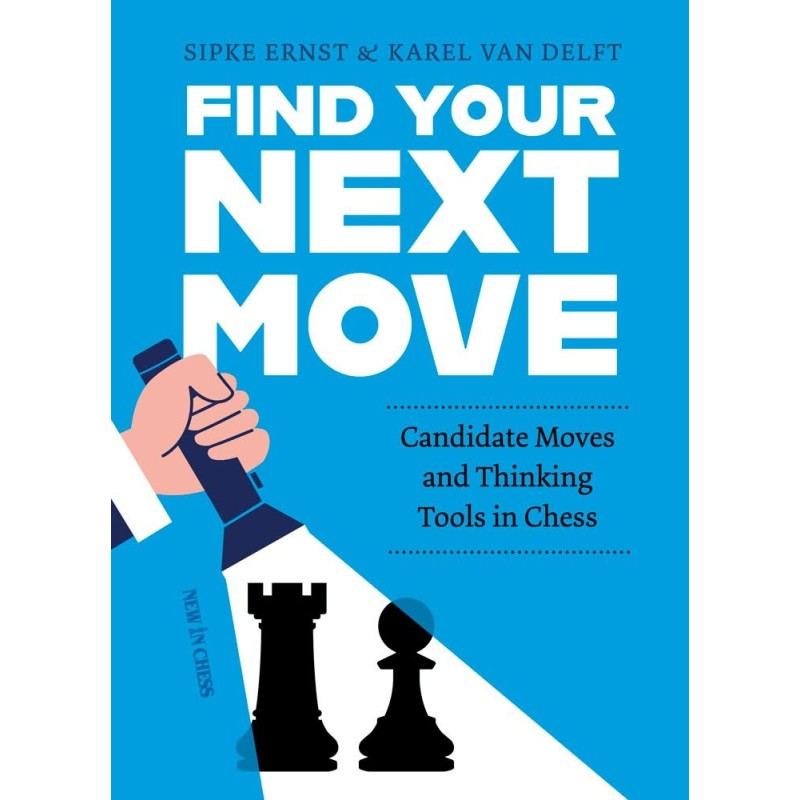
Find Your Next Move : Candidate Moves and Thinking Tools in Chess (Hardcover Ediction) by Karel van Delft and Sipke Ernst. The candidate move is perhaps the most elusive concept in chess theory. First introduced by Alexander Kotov in his famous book Think Like a Grandmaster, it seems clear and methodical enough: when considering a move, you make a list of "candidates" in your mind, compare their merits, and make your choice. But how do you determine what a candidate move is, and how do you proceed from there?
In this book, based on a Chessable course, chess grandmaster Sipke Ernst and chess psychologist Karel van Delft address these questions. First, Ernst offers a practical approach with many original game fragments, divided into four parts with 30 chapters. By studying these fragments the reader becomes familiar with methods such as comparing and eliminating candidate moves, as well as positional methods like prophylaxis and even psychological weapons.
In the fifth part, Van Delft presents thirty thinking tools for finding the best candidate moves. This comprehensive collection of tools is the result of intensive research as well as practical experience during years of youth training. They will help the reader increase their understanding and memory, and develop effective routines and skills. Reading this book will be a great boost to your decision-making in chess!
Sipke Ernst (1979) is a seasoned chess grandmaster and FIDE trainer who has been a member of the Dutch national team. His peak Elo rating is 2606.
Karel van Delft (1956) is a psychologist and a former science project manager with Chessable. He is the author of the book Chess For Educators (New In Chess, 2021) and runs the Apeldoorn Chess Academy in The Netherlands. In 2022, The University of Texas at Dallas Chess Program selected Van Delft as its Chess Educator of the Year.
Fiche technique
In this book, based on a Chessable course, chess grandmaster Sipke Ernst and chess psychologist Karel van Delft address these questions. First, Ernst offers a practical approach with many original game fragments, divided into four parts with 30 chapters. By studying these fragments the reader becomes familiar with methods such as comparing and eliminating candidate moves, as well as positional methods like prophylaxis and even psychological weapons.