- Nouveau

In this comprehensive work on tactical endgames - with the main topics of active king, mating attack, passed pawn and zugzwang - the authors use 100 exemplary positions (20 for each topic) to examine a number of typical scenarios and all kinds of rules of thumb, although they do not neglect to point out the exceptions, which are sometimes almost more important.Almost all of the examples come from current tournaments, from which it can be concluded that the topics covered - in clear contrast to those in the opening phase - are not subject to a zeitgeist, but that they occur consistently and frequently and are practically part of every chess player's daily bread
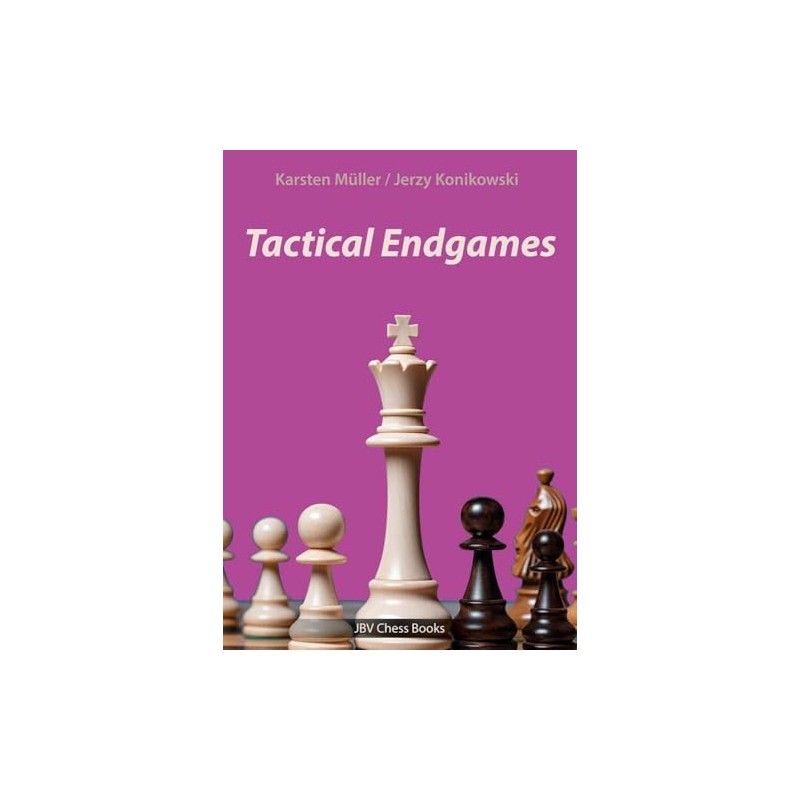
Tactical Endgames by Müller Karsten and Konikowski Jerzy.
In this comprehensive work on tactical endgames - with the main topics of active king, mating attack, passed pawn and zugzwang - the authors use 100 exemplary positions (20 for each topic) to examine a number of typical scenarios and all kinds of rules of thumb, although they do not neglect to point out the exceptions, which are sometimes almost more important.Almost all of the examples come from current tournaments, from which it can be concluded that the topics covered - in clear contrast to those in the opening phase - are not subject to a zeitgeist, but that they occur consistently and frequently and are practically part of every chess player's daily bread. Since it is important to familiarize yourself with them in order to be prepared at the board, readers are then given the opportunity to put their pre-existing and newly acquired knowledge and skills to the test with 50 exercises.In addition, 100 fascinating studies are offered for practice purposes, with emphasis on the fact that these are positions that could well have been taken from a practical game and whose solutions are clearly under- standable.All of the practice exercises can either be approached under tournament conditions, or you can view the book as a pure textbook and deal directly with the solutions without undue effort, because even with this approach it is guaranteed that existing knowledge will be enriched with many typical endgame motifs. In any case, readers can be sure that the magic of the realm of endgames will cast its spell over them too and that they will enjoy the fascination of the final phase of the game.
Fiche technique
In this comprehensive work on tactical endgames - with the main topics of active king, mating attack, passed pawn and zugzwang - the authors use 100 exemplary positions (20 for each topic) to examine a number of typical scenarios and all kinds of rules of thumb, although they do not neglect to point out the exceptions, which are sometimes almost more important.Almost all of the examples come from current tournaments, from which it can be concluded that the topics covered - in clear contrast to those in the opening phase - are not subject to a zeitgeist, but that they occur consistently and frequently and are practically part of every chess player's daily bread