- Nouveau
- Epuisé

English and Réti-type openings have received a tremendous boost over the last decade. Many players now prefer a flexible approach, and with the help of modern chess engines, they are discovering completely new ideas in old but relatively neglected—or, perhaps more accurately, insufficiently explored—variations. One such approach is presented in this book: the Double Fianchetto, together with several modern setups based on an early development of the bishop to b2 and the combination of ideas from different opening systems. This method is employed by many grandmasters today, but it has also enjoyed considerable popularity among World Champions throughout chess history.
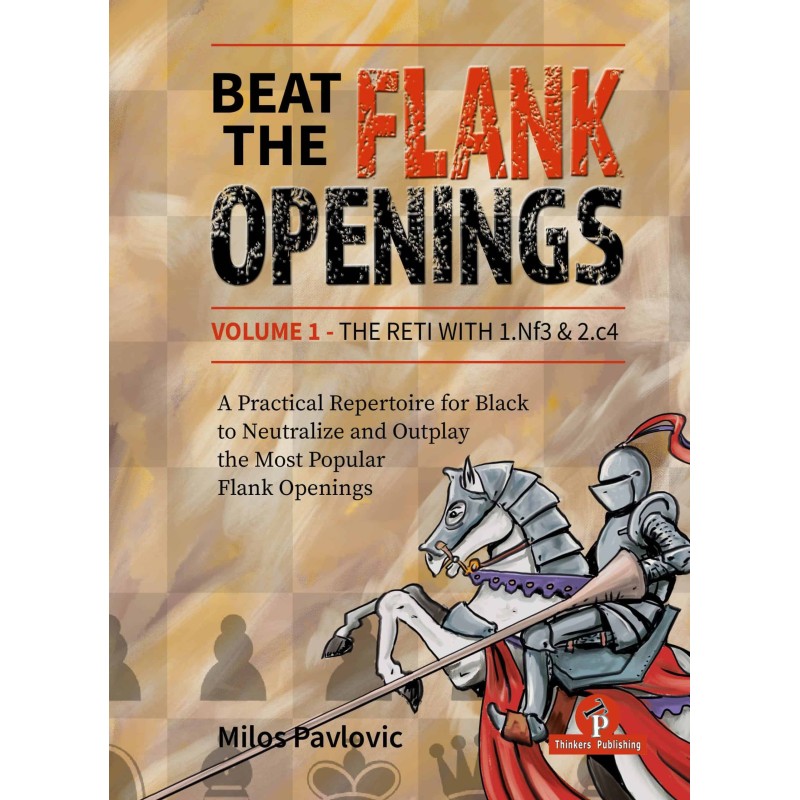
Beat the Flank Openings – Volume 1 : The Reti with 1.Nf3 & 2.c4 – A Practical Repertoire for Black to Neutralize and Outplay the Most Popular Flank Openings – Milos Pavlovic.
English and Réti-type openings have received a tremendous boost over the last decade. Many players now prefer a flexible approach, and with the help of modern chess engines, they are discovering completely new ideas in old but relatively neglected—or, perhaps more accurately, insufficiently explored—variations.
One such approach is presented in this book: the Double Fianchetto, together with several modern setups based on an early development of the bishop to b2 and the combination of ideas from different opening systems. This method is employed by many grandmasters today, but it has also enjoyed considerable popularity among World Champions throughout chess history.
One of the most famous examples is undoubtedly the 24th game of the 1987 World Championship match between Kasparov and Karpov in Seville. Kasparov, playing White, achieved the crucial victory he needed to retain his World Championship title.
For Black, finding an effective antidote to these flexible systems is far from easy. The theory is fluid and often does not revolve around long, forcing variations. Consequently, memorizing concrete lines is less important than developing a thorough understanding of the typical plans, positional ideas, move-order subtleties, and strategic nuances available to both sides.
Fiche technique
English and Réti-type openings have received a tremendous boost over the last decade. Many players now prefer a flexible approach, and with the help of modern chess engines, they are discovering completely new ideas in old but relatively neglected—or, perhaps more accurately, insufficiently explored—variations. One such approach is presented in this book: the Double Fianchetto, together with several modern setups based on an early development of the bishop to b2 and the combination of ideas from different opening systems. This method is employed by many grandmasters today, but it has also enjoyed considerable popularity among World Champions throughout chess history.