- Nouveau
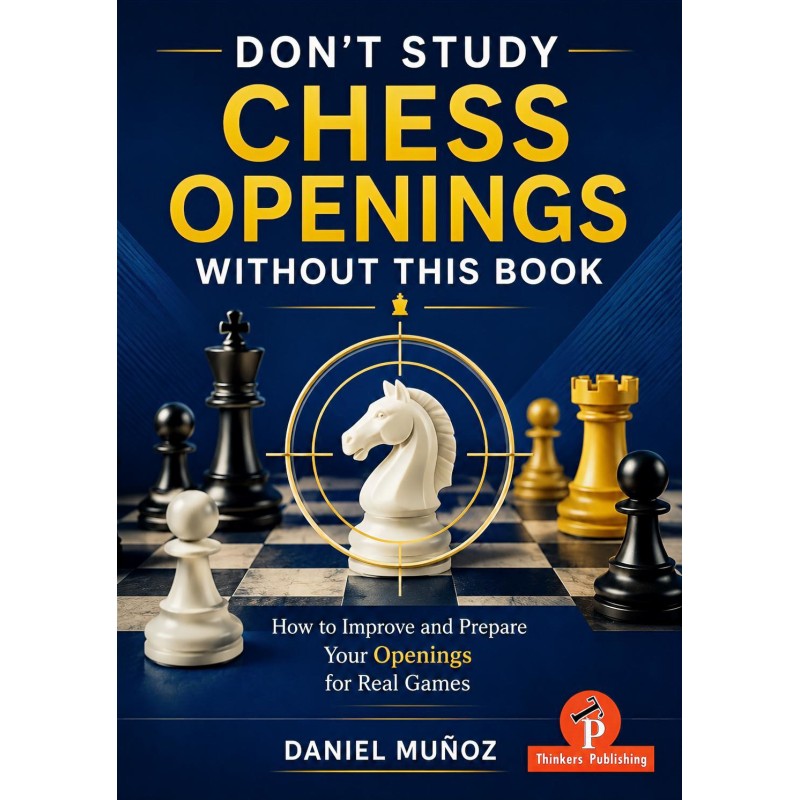

The book is essential reading for every ambitious chess player. An effective approach to opening improvement should focus on understanding the logic behind each move, the relationship between moves, and the ability to adapt to different setups without becoming trapped in a theoretical straitjacket. There is little value in memorizing twenty moves of theory if, once your preparation ends, you are left without a clear plan.
Don’t Study Chess Openings without this Book! by Daniel Munoz.
Real improvement comes from recognizing strategic patterns, mastering typical pawn structures, and understanding the middlegame positions that arise from your chosen openings. This means studying model games, analyzing key transitions from opening to middlegame, and developing training habits that prioritize understanding over the mere accumulation of variations.
Only through such an approach can you build a reliable opening repertoire—one founded not on the fragile thread of memory, but on the enduring strength of genuine chess understanding.
Yet, when working on our openings, how often do we stop to consider the sustainability of our progress? How frequently do we think about the transfer of knowledge between different phases of study, the practical integration of computer-assisted analysis, or the simple reality that chess learning remains a fundamentally human process, regardless of how many databases, engines, and training modules continue to emerge?
This book seeks to answer those questions. Its goal is not merely to help you learn openings, but to help you understand them, retain them, and apply them successfully in practical play.
Fiche technique
The book is essential reading for every ambitious chess player. An effective approach to opening improvement should focus on understanding the logic behind each move, the relationship between moves, and the ability to adapt to different setups without becoming trapped in a theoretical straitjacket. There is little value in memorizing twenty moves of theory if, once your preparation ends, you are left without a clear plan.