
Using a multitude of German sources, the author has crafted a narrative showing how the Nazis completely remade German chess into a monolithic structure to showcase the supposed cultural and intellectual superiority of the "master race." Many games by German masters are presented--Bogoljubow, Richter, Samisch, Rellstab, Kieninger, Junge, and more--and by others who came under Nazi rule: Alekhine, Keres, Eliskases, et al. Important political figures are featured: Otto Zander, Erhardt Post, Hans Schemm, Josef Goebbels, and especially Hans Frank. Politics affecting chess are detailed, both external (e.g., the annexations of Austria and Czechoslovakia) and internal (rivalry between the Grossdeutscher Schachbund and Kraft durch Freude), as of course are the effects of the war and persecution of Jews.
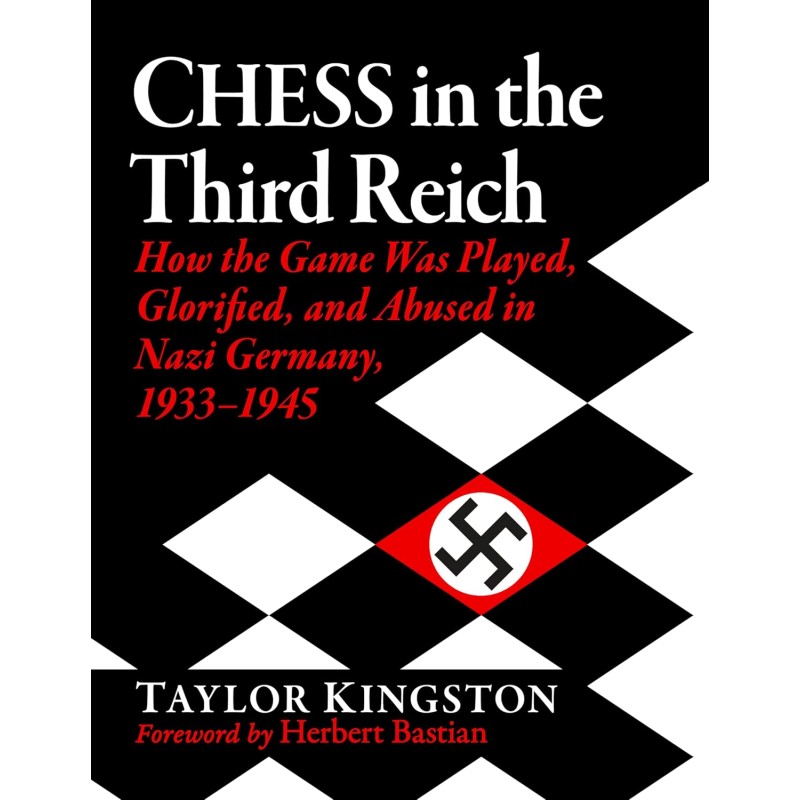
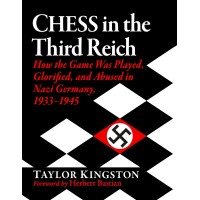
Chess in the Third Reich: How the Game Was Played, Glorified, and Abused in Nazi Germany, 1933-1945 by Taylor Kingston.
The USSR is famous as the first totalitarian state to promote chess. Less well known is that Nazi Germany was the second. The Third Reich gave chess a tremendous financial and propaganda boost in hopes of making Germany a dominant chess power. Yet this aspect of the Nazi era has received scant attention in later German literature, and even less in English. This book fills that gap.
Using a multitude of German sources, the author has crafted a narrative showing how the Nazis completely remade German chess into a monolithic structure to showcase the supposed cultural and intellectual superiority of the "master race." Many games by German masters are presented--Bogoljubow, Richter, Samisch, Rellstab, Kieninger, Junge, and more--and by others who came under Nazi rule: Alekhine, Keres, Eliskases, et al. Important political figures are featured: Otto Zander, Erhardt Post, Hans Schemm, Josef Goebbels, and especially Hans Frank. Politics affecting chess are detailed, both external (e.g., the annexations of Austria and Czechoslovakia) and internal (rivalry between the Grossdeutscher Schachbund and Kraft durch Freude), as of course are the effects of the war and persecution of Jews.
Fiche technique
Using a multitude of German sources, the author has crafted a narrative showing how the Nazis completely remade German chess into a monolithic structure to showcase the supposed cultural and intellectual superiority of the "master race." Many games by German masters are presented--Bogoljubow, Richter, Samisch, Rellstab, Kieninger, Junge, and more--and by others who came under Nazi rule: Alekhine, Keres, Eliskases, et al. Important political figures are featured: Otto Zander, Erhardt Post, Hans Schemm, Josef Goebbels, and especially Hans Frank. Politics affecting chess are detailed, both external (e.g., the annexations of Austria and Czechoslovakia) and internal (rivalry between the Grossdeutscher Schachbund and Kraft durch Freude), as of course are the effects of the war and persecution of Jews.