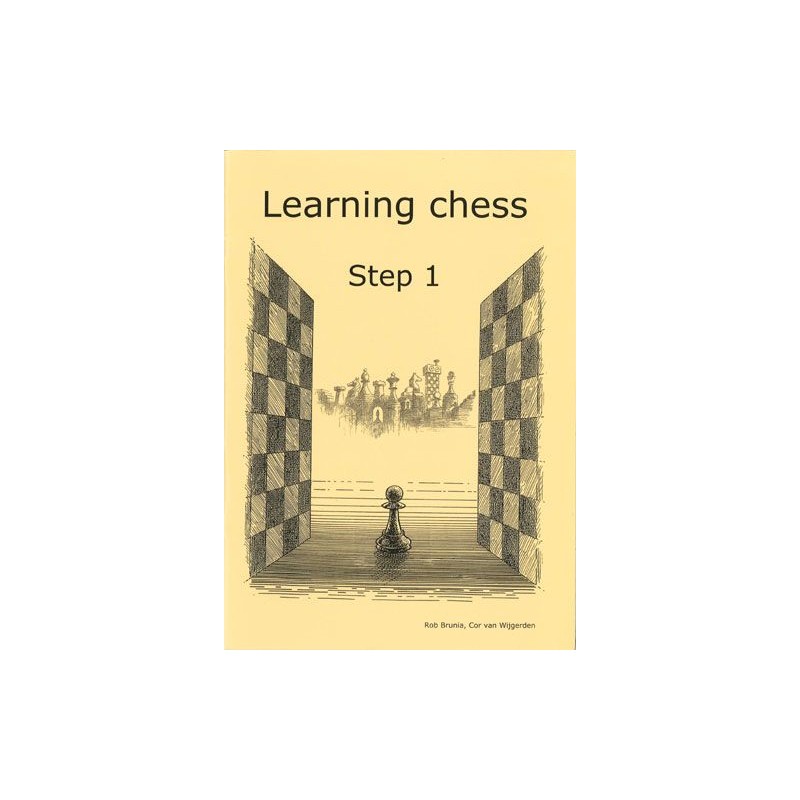

Jouons aux échecs étape 1 (manuel en version anglaise). La Méthode Jouons aux Echecs : Etape 1 de Rob Brunia et Cor van Wijgerden est une méthode didactique destinée à enseigner les échecs aux enfants parue à la fin des années 80. Beaucoup d'écoles et de clubs d'échecs aux Pays-Bas, en Belgique, en Allemagne et en France ont adopté cette méthode en 6 étapes. Outre les exercices, le livre de travail Étape 1 contient également des mémentos. Ce sont de brefs aperçus des leçons du manuel, qui sont destinés aux élèves. Il y a 13 mémentos.
• L'échiquier
• La marche des pièces
• L'attaque et la prise d'une pièce
• Le pion
• La défense
• L'échec et parer l'échec
• Le mat
• Le roque
• L'échange et l'échange favorable
• L'attaque à deux reprises
• La partie nulle
• Le pion 2
• La notation
Les autres 42 pages présentent 12 exercices par page. Cela signifie un total de 42x12-18 (pour les dessins)= 486 exercices.
Les sujets des exercices sont les mêmes que ceux du manuel. Voir le manuel de l'entraineur Etape 1.
Learning chess step 1 :
The step-by-step method has been developed by Rob Brunia and Cor van Wijgerden to teach children to play chess. A large number of schools and chess clubs in the Netherlands, Belgium, Germany, Switzerland and Austria use this method for their chess lessons.
This method consists of six steps. Each step is accompanied with an instruction book with the teaching material to be used by the trainer / teacher / parent and a workbook with exercises for the students.
Step 1
In the first step all the rules of the chess game are introduced. Furthermore, much attention is paid to developing of the basic skills, necessary to play chess. Comparing with other books for beginners the step-by-step method introduces an unique sequence of the teaching material.
Learning how to mate is postponed as long as possible. This sounds astonishing and even incredible but up till now, practice has shown that this approach works perfectly. Children learn to play chess very well, for sure if they get enough time in between to play and practice.
Workbook Step 1. In addition to the exercises there are reminders in the workbook. These are short recapitulations of the lessons in the manual for the pupils. There are 13 reminders:
• The board
• Moves of the pieces
• Attacking and capturing
• The pawn
• Defending
• Check and getting out of check
• Mate
• Castling
• Exchange and profitable exchange
• Twofold attack
• Draw
• The pawn (2)
• The notation
• On the remaining 42 pages there are always 12 positions a page. That means a total number of 42x12-18 (the drawings) = 486 positions.