- Epuisé

This huge book fully takes on board these developments. The most space is devoted to lines that are popular today, and that deep computer analysis suggests have the brightest futures. If an opening cannot be recommended, Kravtsiv explains why with the minimum of variations. He identifies openings more suitable for rapid chess, and what type of work is needed from readers who are interested in playing each opening. Nothing in this book is dictated by the paradigms of older opening works.
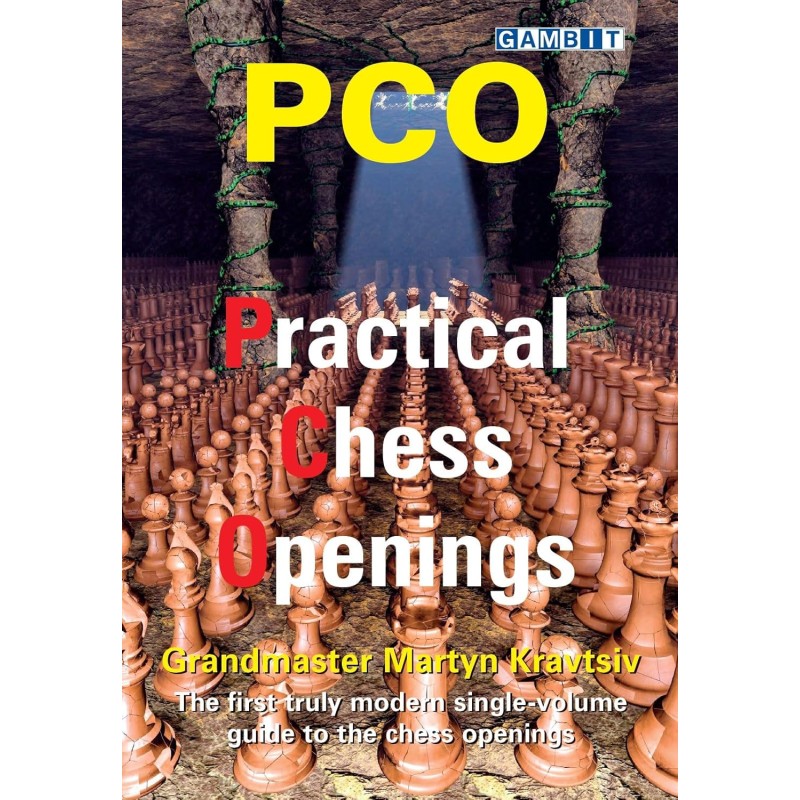
PCO: Practical Chess Openings by Martyn Kravtsiv.
Chess opening theory has changed out of all recognition in the 21st century, yet chess literature has been slow to catch up with this. Martyn Kravtsiv, a grandmaster and trainer of the same generation as Magnus Carlsen, is here to redress the balance.
Prompted by computer investigations, players no longer expect to gain a large advantage as White by force. Few stick to a narrow repertoire. They seek lines that computers underestimate but will cause problems for human opponents. Modest lines with a drop of poison have become fashionable. Yet outlandish gambits and random-looking pawn advances also appear in top-level play. Time-honoured openings have fallen by the wayside, if computers have shown it is too easy to gain an advantage against them, or have simply analysed them to death.
This huge book fully takes on board these developments. The most space is devoted to lines that are popular today, and that deep computer analysis suggests have the brightest futures. If an opening cannot be recommended, Kravtsiv explains why with the minimum of variations. He identifies openings more suitable for rapid chess, and what type of work is needed from readers who are interested in playing each opening. Nothing in this book is dictated by the paradigms of older opening works.
* Covers all openings
* Emphasizes human understanding
* Deals concisely with unreliable lines
* Lavish detail on topical openings
* Explains strategic themes new and old
* Examines ideas from neural networks
Martyn Kravtsiv is a grandmaster from Lviv, Ukraine. He was blitz champion of the 2008 World Mind Sports Games (at age 17), represented his country at the 2017 World Team Championship and was a coach for the team that won silver medals at the 2016 Olympiad. Kravtsiv currently works as a trainer at the children’s chess school in Lviv, and has written three books for Gambit.
Fiche technique
This huge book fully takes on board these developments. The most space is devoted to lines that are popular today, and that deep computer analysis suggests have the brightest futures. If an opening cannot be recommended, Kravtsiv explains why with the minimum of variations. He identifies openings more suitable for rapid chess, and what type of work is needed from readers who are interested in playing each opening. Nothing in this book is dictated by the paradigms of older opening works.