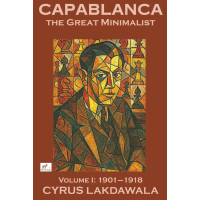
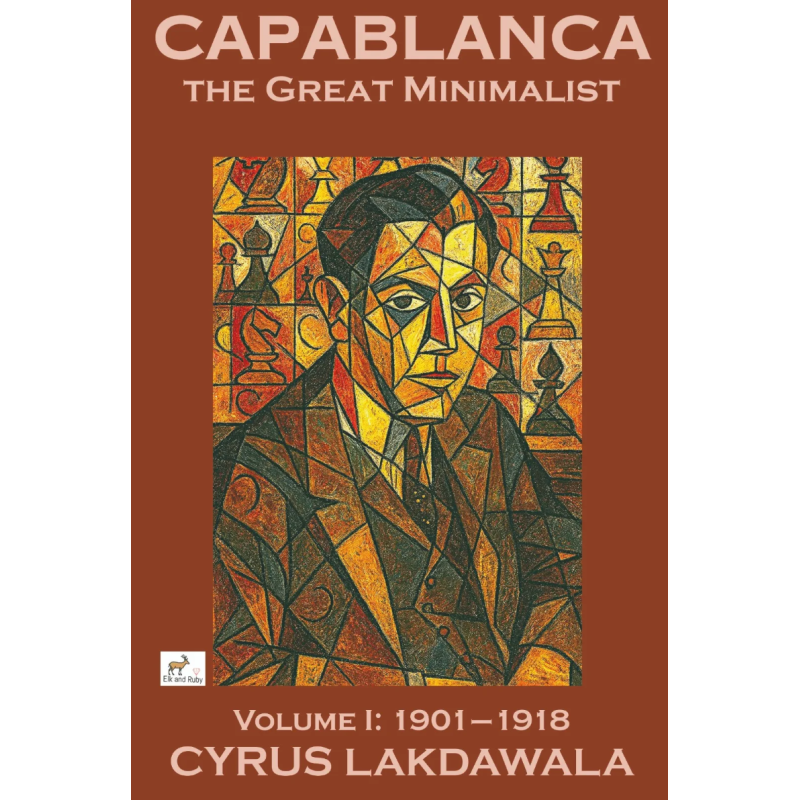

José Raúl Capablanca (1888-1942, World Champion 1921-1927) had a way of posting his pieces on exactly the perfect squares at the perfect time. For his opponents, it almost felt as if Capa’s pieces had a gift for condescension, since they had no need to look for opportunity. Opportunity instead came to them. The position’s optimal plan would magically and instantaneously arrange itself into coherent order within Capa’s chess mind.
Capablanca the Great Minimalist – Volume I : 1901–1918.
Capablanca raised the bar on strategic understanding by at least one full generation. Only a handful of players in chess history were a generation ahead in strategic understanding: Morphy, Steinitz, Capablanca, Fischer, Karpov and Carlsen. The subject of this book and series is the third player on the list. While Capablanca was a player of his time, so advanced were his strategic ideas that he was simultaneously a person of our time as well.
There has never been a chess player who played blemish-free chess, yet some came close. At its best, Capa’s play appears free from obstacles of any kind. To players of that engine-free era, it sometimes felt as if Capablanca played perfect chess. The first time Emanuel Lasker met Capablanca and played blitz against him, he remarked that to his eyes, Capa never appeared to make a mistake.
Beginners often believe that quiet positions and endings are dead, lifeless realms. Play through Capablanca’s games and we see that they teem with life and possibility, since Capa saw hidden meanings in positions where his rivals were blind. He was especially deadly in quiet positions, since he had the unique ability to kill without seeming to strike a blow. By the time his opponents realized the danger, it was often too late to save themselves.
Few of us associate Capablanca with tactics, but maybe we should. He was one of the most tactically aware players of his era, rivaling both Lasker and Alekhine in this metric. Capa’s specialty was short-range combinations, which he almost never missed.
This series will be in three volumes covering the early years, Capa’s prime, and finally the later years. In this book, you will be presented with exercises which you can choose to do or not do. They include: combinations, calculation/visualization, planning and decision-making.
The present volume, number I, contains 156 freshly annotated games and fragments incorporating 168 exercises.
Fiche technique
José Raúl Capablanca (1888-1942, World Champion 1921-1927) had a way of posting his pieces on exactly the perfect squares at the perfect time. For his opponents, it almost felt as if Capa’s pieces had a gift for condescension, since they had no need to look for opportunity. Opportunity instead came to them. The position’s optimal plan would magically and instantaneously arrange itself into coherent order within Capa’s chess mind.